
PRODUCTS SOLD ON PEPTIDESLABIRELAND.COM ARE FOR RESEARCH PURPOSES ONLY AND ARE NOT FOR HUMAN OR VETERINARY USE.
Fast Ireland delivery — dispatched to Dublin, Cork, Galway, Limerick and nationwide.
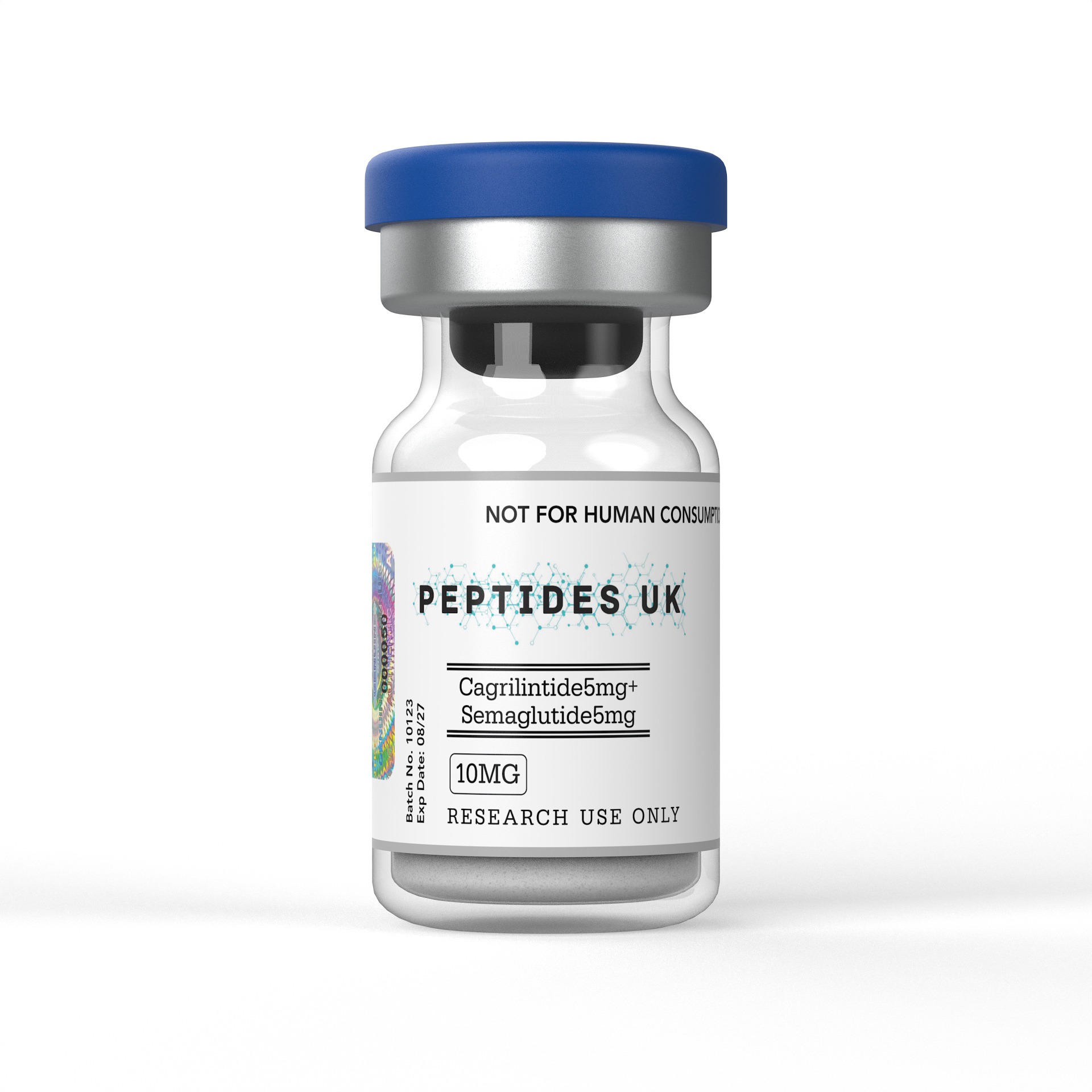
€253.00
Cagrilintide + Semaglutide — co-formulated amylin + GLP-1 agonist research blend used in current-generation metabolic research protocols. HPLC-verified, per-batch COA. Fast Ireland delivery.
For laboratory research use only. Not for human or veterinary use.


Cagrilintide combined with Semaglutide, known in the literature as CagriSema, is a dual amylin and GLP-1 receptor agonist combination studied in metabolic and energy-balance research. It is available to laboratories in Ireland with fast dispatch and full batch documentation.
CagriSema brings together two mechanistically distinct peptide pathways: amylin receptor activation via Cagrilintide and GLP-1 receptor activation via Semaglutide. The pairing has been the subject of a substantial body of published preclinical and clinical-stage research. Researchers and institutions across Ireland can source verified, research-grade Cagrilintide and Semaglutide directly from our Irish peptide supply, with domestic-speed dispatch and complete batch documentation.
✅ ≥99% Purity and HPLC & Mass Spectrometry Verified
✅ Batch-Specific Certificate of Analysis (CoA) Included
✅ Sterile Lyophilised Powder | GMP Manufactured
✅ Fast Dispatch to Ireland | Peptides Ireland Stock
CagriSema is the research and clinical development name for the fixed combination of Cagrilintide and Semaglutide , two long-acting peptide analogues targeting separate but complementary hormonal systems involved in appetite regulation, energy balance, and metabolic control.
Cagrilintide is a long-acting synthetic analogue of amylin, a peptide hormone co-secreted with insulin from pancreatic beta cells. Amylin acts on AMY1, AMY2 and AMY3 receptors in the brainstem and hypothalamus, where studies have investigated its roles in satiety signalling, gastric emptying and post-meal glucagon release. Cagrilintide carries a fatty acid acylation (the same half-life extension approach used in Semaglutide), giving it an extended half-life in pharmacokinetic studies.
Semaglutide is a long-acting GLP-1 receptor agonist and one of the most widely published compounds in GLP-1 pharmacology research. Studies have examined its activity at GLP-1 receptors in the pancreas, brain and gastrointestinal tract, including glucose-dependent insulin secretion, glucagon suppression, gastric emptying and hypothalamic and brainstem satiety signalling. Its albumin-binding fatty acid modification gives it an extended pharmacokinetic profile, which has made it a benchmark long-acting GLP-1R agonist in research.
Together, Cagrilintide and Semaglutide activate two distinct receptor systems . Amylin receptors and GLP-1 receptors , through separate but complementary neurohormonal pathways, producing additive to synergistic effects on appetite suppression, food intake reduction, gastric emptying, and metabolic regulation that exceed what either compound achieves independently.
In controlled laboratory and preclinical settings, the Cagrilintide and Semaglutide combination is studied across a broad range of metabolic and hormonal biology research applications:
Dual Receptor Combination Pharmacology Research . The defining research application of CagriSema is studying the pharmacological interaction between amylin receptor and GLP-1 receptor activation . Examining whether the two pathways produce additive or synergistic effects on appetite, food intake, body weight, and metabolic parameters, and what the mechanistic basis of any synergy is at the receptor, neuronal circuit, and systems biology level.
Energy Balance and Body Weight Research . Published studies have investigated CagriSema in animal models and clinical-stage research, examining body-weight endpoints, timelines, body composition changes and durability compared with GLP-1 monotherapy.
Appetite and Food Intake Research , Studies have examined how combined amylin and GLP-1 receptor activation affects appetite neurobiology and including hypothalamic and brainstem satiety circuit activity, meal size, meal frequency, and food preference in pre-clinical models, Contributing to research on the neurohormonal regulation of energy intake and the complementary roles of amylin and GLP-1 signalling in appetite control.
Gastric Emptying Research . Both amylin and GLP-1 have been shown to slow gastric emptying, and research has examined how combined Cagrilintide and Semaglutide exposure affects gastric emptying rate, nutrient absorption timing and postprandial metabolic responses in experimental models.
Glucose Metabolism and Type 2 Diabetes Research — CagriSema has been studied for combined effects on glucose homeostasis and including fasting and postprandial glucose levels, HbA1c, insulin secretion, glucagon suppression, and insulin sensitivity in metabolic disease models examining how dual amylin/GLP-1 activation compares to GLP-1 monotherapy for glycaemic research endpoints.
Body Composition Research . Studies have examined how CagriSema affects the ratio of fat mass to lean mass change in research models, and whether dual hormonal approaches differ from single-agent compounds in this respect.
Cardiovascular Metabolic Research . Studies have begun examining CagriSema’s effects on cardiovascular markers, including blood pressure, lipid profiles, inflammatory markers and cardiac function parameters, in metabolically compromised research models.
Amylin Receptor Biology Research — Cagrilintide’s contribution to CagriSema makes this combination a valuable tool for studying amylin receptor pharmacology , examining how long-acting AMY receptor activation affects satiety neurobiology, brainstem circuit activity, and metabolic regulation in ways that complement and extend GLP-1 receptor-based research.
Incretin and Gut Hormone Combination Research . CagriSema contributes to the broader field of gut hormone combination pharmacology, which studies how pairing peptides from different hormonal systems compares with single agents, and what this reveals about redundancy, complementarity and synergy in the hormonal systems regulating energy balance.
Body Weight Plateau and Durability Research . Researchers have investigated whether dual receptor activation alters the body-weight plateau reported with GLP-1 monotherapy, examining the biological mechanisms involved and whether engaging a second hormonal pathway changes longer-term body-weight trajectories in study models.
CagriSema is one of the more closely followed combinations in current metabolic research literature:
Comparison with Semaglutide Alone . Published preclinical and early clinical-stage studies have compared CagriSema with Semaglutide monotherapy, reporting larger changes in body-weight endpoints with the combination and investigating whether the effect is additive or synergistic.
Published REDEFINE Programme . The REDEFINE programme is a Phase 3 clinical development programme investigating CagriSema. Its published results are cited by researchers as a reference point for preclinical work on amylin/GLP-1 combination biology.
Complementary Mechanisms . Research indicates that Cagrilintide and Semaglutide activate distinct receptor populations and neuronal circuits, with amylin receptor signalling concentrated in brainstem area postrema and nucleus tractus solitarius pathways and GLP-1 receptor signalling additionally engaging hypothalamic circuits. This provides the mechanistic rationale for studying the two together.
Glucose Metabolism Endpoints . Published studies have measured glucose metabolism parameters, including HbA1c and fasting glucose, with CagriSema, and researchers have examined how amylin receptor and GLP-1 receptor co-activation may contribute to these findings.
Body Composition Data . Studies have examined fat mass versus lean mass changes with CagriSema in research models, and some reports suggest the change is predominantly in fat mass, an area that remains under investigation.
Reported Adverse-Event Findings . Published clinical-stage data describe gastrointestinal effects as the most commonly reported findings, broadly in line with other GLP-1 class compounds. This information is provided as literature context only.
Pre-Clinical Synergy Data . Preclinical combination studies have reported evidence of synergistic rather than purely additive effects on body weight and food intake at certain combination ratios, supporting the hypothesis that amylin and GLP-1 receptor co-activation engages complementary neurobiological mechanisms.
| Feature | CagriSema | Tirzepatide | Semaglutide Alone | Retatrutide |
|---|---|---|---|---|
| Mechanism | GLP-1R + Amylin receptor (AMY1/2/3) | GLP-1R + GIPR | GLP-1R only | GLP-1R + GIPR + Glucagon R |
| Receptor Coverage | Dual , incretin + amylin | Dual , incretin | Single , incretin | Triple , incretin + glucagon |
| Appetite Pathways Engaged | Hypothalamic + brainstem (complementary circuits) | Hypothalamic (overlapping GLP-1/GIP circuits) | Hypothalamic | Hypothalamic + energy expenditure |
| Body Weight Endpoints | Investigated in Phase 3 clinical-stage research | Studied vs semaglutide alone | Reference monotherapy | Very high , triple agonism |
| Glycaemic Research | Strong dual mechanism | Very strong — GIP enhances insulin | Strong | Strong |
| Key Research Distinction | Only amylin + GLP-1 combination | Only GLP-1 + GIP dual agonist | Gold standard GLP-1 reference | Only triple incretin + glucagon agonist |
| Stage of Research | Phase 3 clinical trials | Clinically approved | Clinically approved | Phase 3 clinical trials |
CagriSema is the research combination that targets both the amylin receptor system and the GLP-1 receptor system, engaging brainstem and hypothalamic satiety circuits through complementary neurohormonal pathways. It represents a mechanistically distinct approach from GIP/GLP-1 dual agonism.
| Parameter | Detail |
|---|---|
| Name | Cagrilintide |
| Type | Long-acting synthetic amylin analogue |
| Target | AMY1, AMY2, AMY3 receptors |
| Half-Life | ~7 days half-life |
| Mechanism | Amylin receptor activation , satiety / gastric emptying / glucagon suppression |
| Purity | ≥99% HPLC & MS Verified |
| Form | Sterile Lyophilised Powder |
| Storage (Powder) | -20°C, protect from light |
| Parameter | Detail |
|---|---|
| Name | Semaglutide |
| Type | Long-acting GLP-1 receptor agonist |
| Target | GLP-1 receptor |
| Half-Life | ~7 days half-life |
| Mechanism | GLP-1R activation and insulin secretion / appetite suppression / gastric emptying |
| Purity | ≥99% HPLC & MS Verified |
| Form | Sterile Lyophilised Powder |
| Storage (Powder) | -20°C, protect from light |
Every order of Cagrilintide and Semaglutide in Ireland includes:
✅ Batch-Specific Certificate of Analysis (CoA) for each compound
✅ HPLC Chromatogram
✅ Mass Spectrometry Confirmation
✅ Sterility & Endotoxin Testing Report
✅ Reconstitution Protocol
✅ Technical Research Support
Can I buy Cagrilintide and Semaglutide in Ireland? Yes , we supply research-grade Cagrilintide and Semaglutide to researchers and institutions across Ireland with fast dispatch and full batch documentation for each compound. These compounds are supplied strictly for laboratory research purposes only.
What is CagriSema and why is it studied in metabolic research? CagriSema is the combination of Cagrilintide, a long-acting amylin analogue, and Semaglutide, a long-acting GLP-1 receptor agonist. Researchers study it to understand how two complementary hormonal pathways interact. Published data from the REDEFINE programme have made it one of the most closely followed combinations in current metabolic science.
How do Cagrilintide and Semaglutide work differently from each other? Semaglutide activates GLP-1 receptors primarily in the hypothalamus, brainstem, pancreas, and gastrointestinal tract , stimulating insulin secretion, suppressing glucagon, slowing gastric emptying, and reducing appetite through incretin signalling. Cagrilintide activates amylin receptors and particularly in the brainstem area postrema and nucleus tractus solitarius , reducing appetite, slowing gastric emptying, and suppressing post-meal glucagon through a separate neurohormonal pathway. The two compounds engage complementary neurological circuits and receptor systems, which is the mechanistic basis for their combined effects exceeding either alone.
How does CagriSema compare to Tirzepatide? Tirzepatide is a dual GLP-1R/GIPR agonist, combining GLP-1 and GIP receptor activation in a single molecule. CagriSema combines GLP-1 receptor activation with amylin receptor activation, a different receptor pairing that engages distinct neurobiological pathways. Both have been compared with GLP-1 monotherapy in published research, which makes them complementary rather than equivalent research tools for studying multi-receptor pharmacology.
What is the REDEFINE programme? REDEFINE is the Phase 3 clinical development programme investigating CagriSema. Its published body-weight and metabolic findings have generated significant scientific interest in amylin/GLP-1 combination biology.
What purity is recommended for CagriSema research? ≥99% purity is strongly recommended for receptor binding assays, in vitro pharmacology, preclinical metabolic models, and any research where compound quality directly affects receptor activation potency and reproducibility of metabolic endpoints. All Cagrilintide and Semaglutide Ireland stock is independently verified to ≥99%.
How do I reconstitute Cagrilintide and Semaglutide for laboratory use? Allow each vial to reach room temperature before opening. Both compounds reconstitute in sterile water or bacteriostatic water and add solvent slowly down the inside wall of the vial and swirl gently without shaking. Use promptly after reconstitution or aliquot and store at -80°C to preserve peptide integrity and biological activity. Prepare each compound as a separate stock solution and combine at working concentration as required by the research protocol.
Cagrilintide and Semaglutide are supplied exclusively for legitimate scientific research purposes conducted within licensed laboratory environments. These products aren’t intended for human consumption, self-administration, or any therapeutic application. They must be handled by qualified researchers in compliance with applicable Irish and EU regulations and institutional ethics guidelines. By purchasing, you confirm that these compounds will be used solely for approved in-vitro or pre-clinical research purposes.
Cagrilintide + Semaglutide isn’t authorised as a medicine by the HPRA. It’s legal to buy, hold and use as a research chemical for in-vitro laboratory work, and that’s the only use we supply it for. If you want the full regulatory picture, see our Irish researcher’s guide to peptide legality.
Every vial ships with an HPLC purity trace (≥99%), mass-spec identity confirmation, and endotoxin/heavy-metal screening on the batch. The full per-batch Certificate of Analysis is available on request from [email protected]. Our quality system is ISO 9001 certified and third-party testing runs through a UKAS-accredited lab.
Standard protocol: let the Cagrilintide + Semaglutide vial and your bacteriostatic water come to room temperature, wipe both stoppers with a 70% isopropyl swab, then add the water slowly down the side wall of the peptide vial. Don’t stream directly onto the powder cake. Swirl gently, don’t shake, and give it five to ten minutes to fully dissolve. Label the vial with compound, concentration and reconstitution date, store at 2–8°C between assays.
Same-day dispatch on orders placed before 2pm on a working day. Delivery is 24–48 hours to any Irish county via An Post Express or DPD. Cold chain is preserved with insulated wrap plus gel pack. No customs step, no border delays , because it never leaves Ireland.
In the Irish research space Cagrilintide + Semaglutide tends to appear in GLP-1 receptor signalling and glucose-homeostasis research. It’s often paired with Tirzepatide or Retatrutide in comparison studies when researchers are studying combined mechanisms rather than the compound alone.
Lyophilised Cagrilintide + Semaglutide is refrigerated post-reconstitution, working shelf life 14–28 days. Once reconstituted, keep it refrigerated at 2–8°C and use within the working shelf life described on the CoA. Freeze/thaw cycles degrade peptides, so aliquot the reconstituted solution if you plan to run assays over several weeks.


Receive News