PRODUCTS SOLD ON PEPTIDESLABIRELAND.COM ARE FOR RESEARCH PURPOSES ONLY AND ARE NOT FOR HUMAN OR VETERINARY USE.
Fast Ireland delivery — dispatched to Dublin, Cork, Galway, Limerick and nationwide.
€45.50
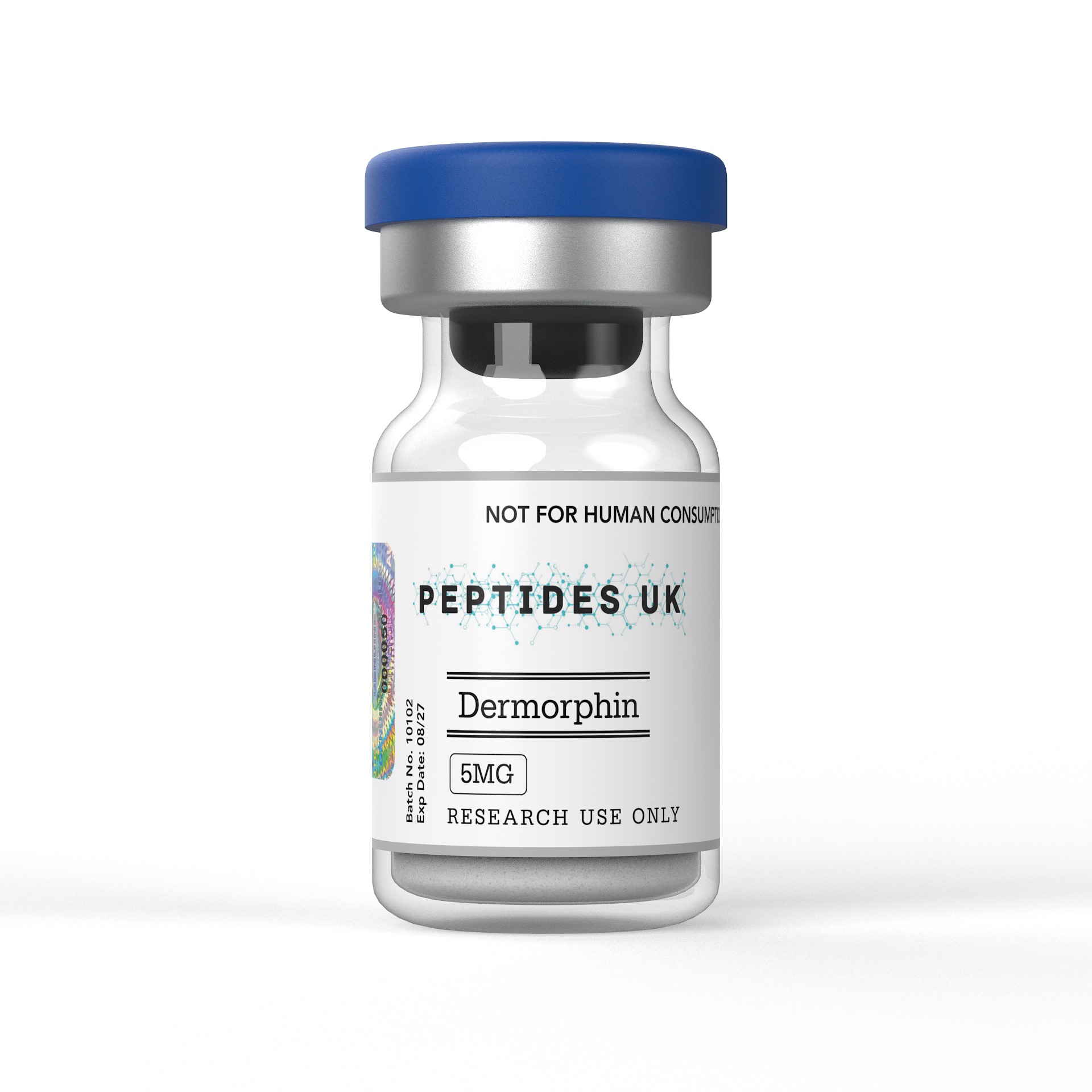
Dermorphin — synthetic 7 amino acid μ-opioid receptor selective agonist research reference. Studied in opioid receptor pharmacology research. HPLC-verified ≥99% purity, per-batch COA. Fast Ireland delivery.
For laboratory research use only. Not for human or veterinary use.


Dermorphin is a naturally occurring heptapeptide opioid first isolated from the skin of South American tree frogs . One of the most potent and selective mu-opioid receptor agonists known to science and a uniquely significant research tool in opioid receptor pharmacology, pain biology, and neuroscience research , available to buy in Ireland with fast dispatch and full batch documentation included.
Dermorphin (Tyr-D-Ala-Phe-Gly-Tyr-Pro-Ser-NH₂) is extraordinary among naturally occurring peptides for containing a D-amino acid and D-Alanine at position 2 and a feature almost without precedent in vertebrate biology that confers exceptional mu-opioid receptor selectivity, high proteolytic stability, and a potency far exceeding that of morphine in pre-clinical research models, Researchers and institutions across Ireland can source verified, research-grade Dermorphin directly from our Irish peptide supply, with domestic-speed dispatch and complete batch documentation.
✅ ≥99% Purity . HPLC & Mass Spectrometry Verified
✅ Batch-Specific Certificate of Analysis (CoA) Included
✅ Sterile Lyophilised Powder | GMP Manufactured
✅ Fast Dispatch to Ireland | Peptides Ireland Stock
Dermorphin is a naturally occurring heptapeptide and seven amino acids in sequence: Tyr-D-Ala-Phe-Gly-Tyr-Pro-Ser-NH₂ . First isolated in 1981 from the skin secretions of the South American tree frog Phyllomedusa sauvagei by Vittorio Erspamer and colleagues at the University of Rome. Its discovery was immediately significant for two reasons: it was one of the first naturally occurring peptides found to contain a D-amino acid in an animal , specifically D-Alanine at position 2 rather than the L-Alanine that standard vertebrate biosynthetic machinery produces . And it demonstrated opioid receptor binding potency dramatically exceeding that of morphine.
The presence of D-Alanine at position 2 isn’t an accident of biosynthesis but a post-translational modification , the peptide is initially synthesised with L-Alanine and subsequently epimerised to D-Alanine by a dedicated peptide isomerase enzyme in the frog skin. This D-amino acid incorporation serves a clear biological function: it dramatically improves the peptide’s resistance to proteolytic degradation and since most proteases cleave L-amino acid bonds and are unable to efficiently process D-amino acid-containing sequences . And it optimises the three-dimensional conformation of the peptide for high-affinity binding to the mu-opioid receptor.
Dermorphin binds to mu-opioid receptors (MOR) with exceptionally high affinity and selectivity with studies documenting binding affinities in the subnanomolar range and a selectivity for mu over delta and kappa opioid receptors that makes it one of the most pharmacologically clean mu-opioid receptor research tools available from a natural source. This combination of high potency, exceptional MOR selectivity, and proteolytic stability . All in a relatively small seven-amino acid structure has made Dermorphin one of the most important and widely studied peptides in opioid receptor pharmacology and pain research.
In controlled laboratory and pre-clinical settings, Dermorphin is studied across a range of opioid receptor pharmacology, pain biology, and neuroscience research applications:
Mu-Opioid Receptor Pharmacology Research , Dermorphin’s primary and most significant research application is as a highly selective mu-opioid receptor (MOR) agonist — used to study MOR binding characteristics, receptor activation kinetics, downstream signalling cascades, and the pharmacological consequences of selective MOR stimulation in cell-based and pre-clinical models. Its exceptional MOR selectivity over delta and kappa receptors makes it a pharmacologically cleaner research tool than non-selective opioid compounds for isolating MOR-specific biology.
Opioid Receptor Binding Research and Dermorphin is used in radioligand binding assays and competitive binding studies to characterise mu-opioid receptor expression, density, and affinity in membrane preparations and cell models — serving as a reference ligand for MOR pharmacology research and as a tool for studying how receptor occupancy relates to downstream signalling and biological responses.
Pain Biology and Analgesia Research , As a potent MOR agonist, Dermorphin has been studied extensively in pre-clinical pain models , with research examining its analgesic potency, duration of action, and mechanism of analgesia across acute, inflammatory, and neuropathic pain model systems. Studies have used Dermorphin to investigate the neurobiological basis of opioid analgesia, the central and peripheral sites of MOR-mediated pain modulation, and how peptide opioids compare to alkaloid opioids in analgesic mechanism and receptor pharmacology.
Opioid Receptor Structure-Activity Relationship Research , Dermorphin’s unique structure . Particularly its D-amino acid at position 2 and C-terminal amidation , has made it a central tool in opioid peptide structure-activity relationship (SAR) studies. Research has systematically modified Dermorphin’s sequence to examine which structural features determine MOR selectivity, binding affinity, and agonist efficacy , generating a large body of SAR data that has contributed substantially to the understanding of how peptide ligands interact with the mu-opioid receptor binding pocket.
D-Amino Acid Biology Research and Dermorphin is one of the most studied naturally occurring D-amino acid-containing peptides in vertebrate biology , and has been used as a model compound for studying the biological consequences of D-amino acid incorporation in peptides, including effects on proteolytic stability, receptor binding geometry, and pharmacokinetic profile. This research has contributed to the broader understanding of D-amino acid peptide biology and the deliberate incorporation of D-amino acids as a peptide engineering strategy.
Opioid Receptor Signalling Research and Studies have used Dermorphin to examine the intracellular signalling cascades activated by MOR stimulation . Including Gi/o protein coupling, cAMP suppression, MAPK pathway activation, β-arrestin recruitment, and receptor internalisation and desensitisation. Research has examined how Dermorphin-driven MOR activation compares to other MOR agonists in its signalling bias profile and contributing to the understanding of biased agonism at the mu-opioid receptor.
Opioid Tolerance and Dependence Research , Pre-clinical studies have examined Dermorphin in the context of opioid tolerance and dependence biology . Using its potent and selective MOR agonism to study the neuroadaptive changes that occur with repeated MOR stimulation, including receptor downregulation, desensitisation, and the neurobiological basis of opioid tolerance in pre-clinical models.
Central Nervous System Research and Dermorphin is used to study the distribution and function of mu-opioid receptors across central nervous system regions , examining MOR expression in pain-processing circuits, reward pathways, respiratory control centres, and autonomic nuclei through receptor binding, autoradiography, and functional studies using Dermorphin as a selective MOR probe.
Cardiovascular Opioid Research . Opioid receptors are expressed in cardiovascular tissue , including cardiac muscle and vascular smooth muscle , and studies have examined Dermorphin’s effects on cardiovascular parameters including heart rate, blood pressure, and cardiac contractility in pre-clinical models, contributing to the understanding of peripheral MOR biology beyond the central nervous system.
Peptide Drug Design and Opioid Analogue Research . Dermorphin has served as a structural template for the design of novel opioid peptide analogues , with research groups using its sequence and D-amino acid architecture as a starting point for developing modified peptides with altered selectivity profiles, improved pharmacokinetic properties, or biased signalling characteristics. This drug design research has generated a significant body of synthetic opioid peptide literature built on Dermorphin’s structural foundation.
Dermorphin has a well-established and scientifically significant research profile spanning over four decades since its initial isolation:
Exceptional MOR Potency Confirmed , Pharmacological studies have consistently confirmed Dermorphin’s extraordinary mu-opioid receptor potency . With binding affinity assays documenting Ki values in the subnanomolar range at MOR and receptor activation studies confirming full agonist efficacy at MOR . Establishing it as one of the most potent naturally occurring MOR agonists identified from any biological source.
High MOR Selectivity Over Delta and Kappa Receptors . Receptor selectivity studies have confirmed Dermorphin’s substantial preference for mu over delta and kappa opioid receptors — with selectivity ratios documenting many-fold preference for MOR in competitive binding assays and establishing the pharmacological basis for its use as a selective MOR research tool in studies requiring clean receptor subtype discrimination.
Analgesic Potency in Pre-Clinical Pain Models , Pre-clinical analgesia studies have documented Dermorphin’s potent analgesic activity across hot plate, tail flick, and inflammatory pain models , with studies reporting analgesic potency substantially exceeding that of morphine on a molar basis following central administration, consistent with its high MOR binding affinity and full agonist efficacy at pain-processing MOR populations.
Proteolytic Stability Attributed to D-Alanine and Studies have confirmed that Dermorphin’s D-Alanine at position 2 is the primary structural feature responsible for its enhanced proteolytic resistance compared to the all-L-amino acid analogue , with degradation studies documenting significantly slower enzymatic breakdown of Dermorphin compared to structurally similar L-amino acid peptides, confirming the functional significance of the D-amino acid in extending the peptide’s biological half-life.
Structure-Activity Relationship Data , Four decades of Dermorphin SAR research has generated extensive structure-activity data across systematic sequence modifications and identifying the key pharmacophoric elements required for MOR binding and selectivity, the structural tolerance for modification at each position, and how changes to the D-Ala residue, C-terminal amide, and individual side chains affect receptor affinity, selectivity, and agonist efficacy. This SAR literature represents one of the most comprehensive pharmacological characterisations of any opioid peptide.
Signalling Bias Research , More recent studies have examined Dermorphin in the context of biased agonism at the mu-opioid receptor , comparing its G protein versus β-arrestin recruitment profile to other MOR agonists and examining what its signalling characteristics reveal about the structural basis of functional selectivity at opioid receptors , contributing to one of the most active current areas of opioid receptor research.
D-Amino Acid Post-Translational Modification Characterised and Research has characterised the biosynthetic pathway responsible for D-Alanine incorporation in Dermorphin . Identifying the peptide isomerase enzyme responsible for L-to-D epimerisation and establishing this as a genuine post-translational modification rather than a biosynthetic error and contributing to the broader understanding of D-amino acid biology in animal peptides.
| Feature | Dermorphin | DAMGO | Endomorphin-1 | DPDPE |
|---|---|---|---|---|
| Origin | Natural — frog skin (Phyllomedusa sauvagei) | Synthetic enkephalin analogue | Natural , mammalian endogenous | Synthetic enkephalin analogue |
| Sequence Length | 7 amino acids | 5 amino acids | 4 amino acids | 5 amino acids |
| Receptor Selectivity | Mu (MOR) and highly selective | Mu (MOR) , highly selective | Mu (MOR) . Highly selective | Delta (DOR) — highly selective |
| D-Amino Acid | Yes , D-Ala at position 2 (natural) | Yes , D-Ala at position 2 (synthetic) | No | Yes , D-Pen at positions 2 and 5 |
| Potency vs Morphine | Very High , substantially exceeds morphine | High | High | N/A and delta selective |
| Proteolytic Stability | High and D-amino acid conferred | High . D-amino acid conferred | Moderate | High . D-amino acid conferred |
| Key Research Use | Natural MOR agonist / SAR template / D-amino acid biology | Gold standard synthetic MOR agonist | Endogenous MOR agonist biology | Gold standard DOR agonist |
| Key Distinction | Only naturally occurring D-amino acid vertebrate opioid peptide | Most widely used synthetic MOR research tool | Only endogenous tetrapeptide MOR agonist | Most widely used selective DOR agonist |
Dermorphin occupies a unique position in opioid research as the only naturally occurring vertebrate peptide combining a D-amino acid with exceptional mu-opioid receptor potency and selectivity and giving it both pharmacological significance as a research tool and biological significance as a model for studying D-amino acid peptide biology in nature.
| Parameter | Detail |
|---|---|
| Name | Dermorphin |
| Sequence | Tyr-D-Ala-Phe-Gly-Tyr-Pro-Ser-NH₂ |
| Length | 7 amino acids (heptapeptide) |
| C-Terminus | Amidated (-NH₂) |
| D-Amino Acid | D-Alanine at position 2 |
| Source | Originally isolated from Phyllomedusa sauvagei , supplied as synthetic research-grade compound |
| Primary Target | Mu-opioid receptor (MOR) |
| Mechanism | Highly selective MOR agonism |
| Key Research Areas | Opioid receptor pharmacology / pain biology / SAR research / D-amino acid biology |
| Purity | ≥99% HPLC & MS Verified |
| Form | Sterile Lyophilised Powder |
| Solubility | Sterile water, PBS, dilute acetic acid if required |
| Storage (Powder) | -20°C, protect from light |
| Storage (Reconstituted) | -20°C, use promptly after thawing |
| Manufacturing | GMP Manufactured |
Every order of Dermorphin in Ireland includes:
✅ Batch-Specific Certificate of Analysis (CoA)
✅ HPLC Chromatogram
✅ Mass Spectrometry Confirmation
✅ Sterility & Endotoxin Testing Report
✅ Reconstitution Protocol
✅ Technical Research Support
Can I buy Dermorphin in Ireland? Yes , we supply research-grade Dermorphin to researchers and institutions across Ireland with fast dispatch and full batch documentation. This compound is supplied strictly for laboratory research purposes only within licensed research environments.
What is Dermorphin and where does it come from? Dermorphin is a naturally occurring heptapeptide first isolated in 1981 from the skin secretions of the South American tree frog Phyllomedusa sauvagei. It is one of the most potent naturally occurring mu-opioid receptor agonists identified from any biological source, and is notable for containing a D-amino acid and D-Alanine at position 2 , a feature almost without precedent in naturally occurring vertebrate peptides that confers exceptional proteolytic stability and optimises MOR binding geometry. The research-grade Dermorphin supplied for Ireland researchers is synthetic, produced to ≥99% purity with full analytical verification.
What makes Dermorphin significant compared to other opioid research tools? Dermorphin’s significance stems from three converging features and its exceptional mu-opioid receptor potency substantially exceeding morphine, its high MOR selectivity over delta and kappa receptors providing pharmacologically clean MOR research, and its naturally occurring D-amino acid content making it the defining model compound for studying D-amino acid biology in vertebrate peptides. No other naturally occurring vertebrate peptide combines these three features, giving Dermorphin a unique and irreplaceable position in both opioid pharmacology and D-amino acid peptide research.
What is the significance of the D-Alanine in Dermorphin? The D-Alanine at position 2 of Dermorphin is one of the most studied examples of naturally occurring D-amino acid incorporation in vertebrate biology. It serves two clear functions — it confers proteolytic resistance by disrupting normal protease recognition and cleavage at the D-amino acid bond, significantly extending the peptide’s biological half-life compared to an all-L-amino acid analogue, and it optimises the three-dimensional conformation of the peptide N-terminus for high-affinity binding to the mu-opioid receptor binding pocket. Research characterising the biosynthetic isomerase responsible for this L-to-D epimerisation has contributed to the fundamental understanding of post-translational D-amino acid modification in animal peptides.
How does Dermorphin compare to DAMGO as a MOR research tool? DAMGO ([D-Ala², N-MePhe⁴, Gly-ol]-enkephalin) is the most widely used synthetic mu-opioid receptor agonist in research , a modified enkephalin analogue designed with D-Ala at position 2 for stability. Dermorphin is the naturally occurring counterpart . Providing a biologically derived MOR agonist with comparable selectivity and potency but a distinct seven-amino acid structure that has generated its own extensive SAR literature. The two compounds are complementary MOR research tools , DAMGO as the gold-standard synthetic reference, Dermorphin as the natural MOR agonist model and structural template for opioid peptide drug design research.
What purity is recommended for Dermorphin research? ≥99% purity is strongly recommended for mu-opioid receptor binding assays, functional agonism studies, SAR research, pain model experiments, and any pre-clinical research where compound quality directly affects receptor pharmacology measurements and experimental reproducibility. All Dermorphin Ireland stock is independently verified to ≥99%.
How do I reconstitute Dermorphin for laboratory use? Allow the vial to reach room temperature before opening. Dermorphin reconstitutes in sterile water or PBS for most research applications and add solvent slowly down the inside wall of the vial and swirl gently without shaking. If solubility is challenging at higher concentrations, a small volume of dilute acetic acid can be used as an initial dissolution vehicle before dilution to working concentration in aqueous buffer. Store reconstituted solutions at -20°C protected from light and avoid repeated freeze-thaw cycles to preserve peptide integrity and receptor binding activity.
Dermorphin is supplied exclusively for legitimate scientific research purposes conducted within licensed laboratory environments. This product isn’t intended for human consumption, self-administration, or any therapeutic application. It must be handled by qualified researchers in strict compliance with applicable Irish and EU regulations, institutional ethics guidelines, and all relevant controlled substance and research governance frameworks. By purchasing, you confirm that this compound will be used solely for approved in-vitro or pre-clinical research purposes within a licensed research setting.
Dermorphin isn’t authorised as a medicine by the HPRA. It’s legal to buy, hold and use as a research chemical for in-vitro laboratory work, and that’s the only use we supply it for. If you want the full regulatory picture, see our Irish researcher’s guide to peptide legality.
Every vial ships with an HPLC purity trace (often ≥99%), mass-spec identity confirmation, and endotoxin/heavy-metal screening on the batch. The full per-batch Certificate of Analysis is available on request from research@peptideslabireland.com. Our quality system is ISO 9001 certified and third-party testing runs through a UKAS-accredited lab.
Standard protocol: let the Dermorphin vial and your bacteriostatic water come to room temperature, wipe both stoppers with a 70% isopropyl swab, then inject the water slowly down the side wall of the peptide vial. Don’t stream directly onto the powder cake. Swirl gently, don’t shake, and give it five to ten minutes to fully dissolve. Label the vial with compound, concentration and reconstitution date, store at 2–8°C between assays.
Same-day dispatch on orders placed before 2pm on a working day. Delivery is 24–48 hours to any Irish county via An Post Express or DPD. Cold chain is preserved with insulated wrap plus gel pack. No customs step, no border delays and because it never leaves Ireland.
In the Irish research space Dermorphin tends to appear in tissue repair and healing pathways. It’s often paired with TB-500 or GHK-Cu in dual-compound studies when researchers are studying combined mechanisms rather than the compound alone.
Lyophilised Dermorphin is stable at ≤-20°C long-term. Once reconstituted, keep it refrigerated at 2–8°C and use within the working shelf life described on the CoA. Freeze/thaw cycles degrade peptides, so aliquot the reconstituted solution if you plan to run assays over several weeks.

Receive News