PRODUCTS SOLD ON PEPTIDESLABIRELAND.COM ARE FOR RESEARCH PURPOSES ONLY AND ARE NOT FOR HUMAN OR VETERINARY USE.
Fast Ireland delivery — dispatched to Dublin, Cork, Galway, Limerick and nationwide.
€60.00
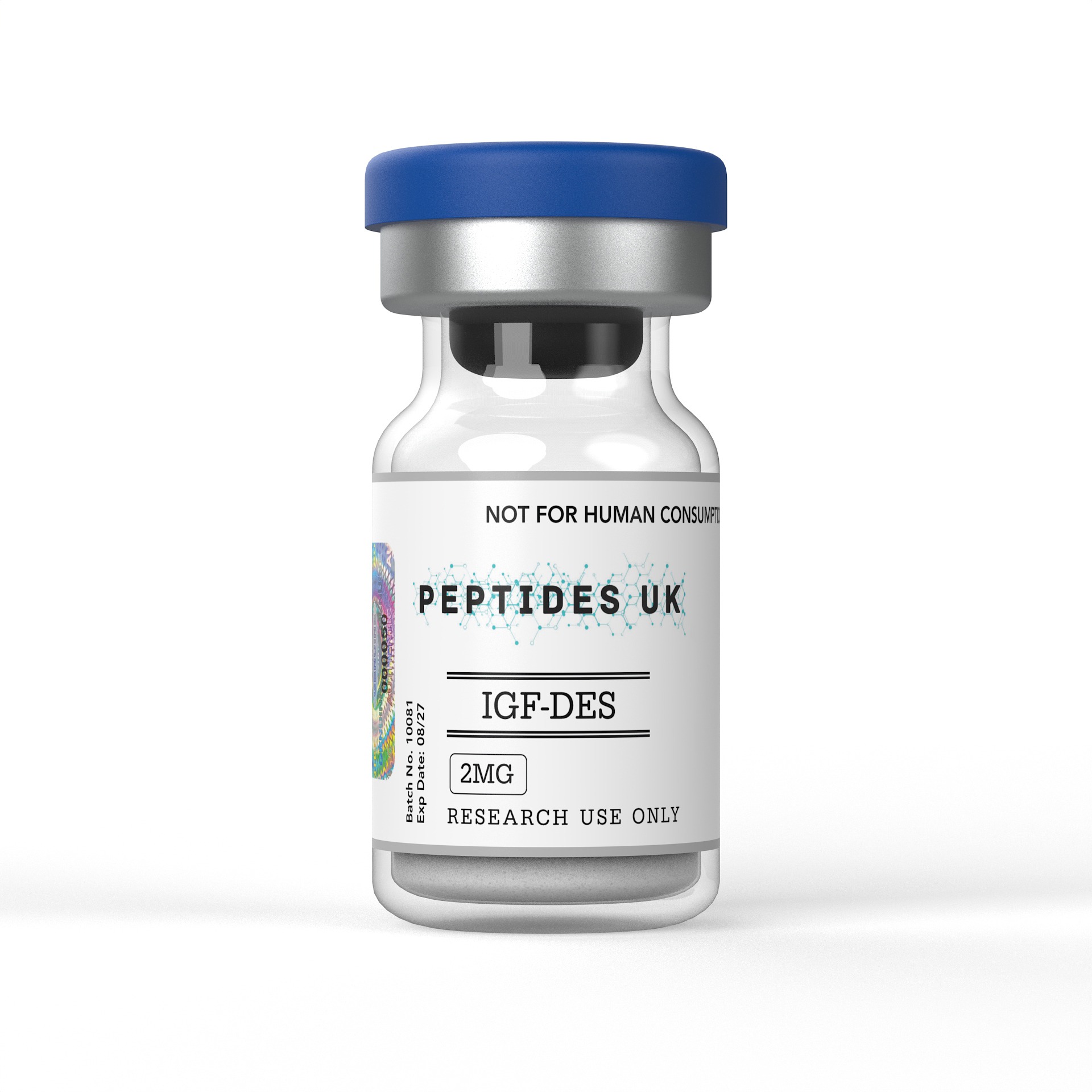
IGF-DES — truncated IGF-1 (des-1-3) analogue with reduced binding-protein affinity, studied in IGF-axis pharmacology research. HPLC-verified ≥99% purity, per-batch COA. Fast Ireland delivery.
For laboratory research use only. Not for human or veterinary use.



IGF-DES (Des(1-3)IGF-1) is a naturally occurring, truncated variant of IGF-1 with the first three N-terminal amino acids removed . Producing a potent, locally acting growth factor analogue with dramatically reduced IGF-binding protein affinity and uniquely enhanced potency at the IGF-1 receptor and one of the most significant compounds in local tissue growth factor biology, muscle satellite cell research, and hyperplasia versus hypertrophy research and available to buy in Ireland with fast dispatch and full batch documentation included.
IGF-DES retains full IGF-1 receptor binding and activation capacity while exhibiting around 10-fold greater potency than native IGF-1 in biological activity assays and a potency enhancement attributed to the removal of the N-terminal tripeptide that contributes to IGFBP binding , making it the most potent naturally occurring IGF-1 variant identified and a uniquely valuable research tool for studying local autocrine and paracrine IGF-1 signalling in tissue repair, muscle biology, and growth factor receptor pharmacology, Researchers and institutions across Ireland can source verified, research-grade IGF-DES directly from our Irish peptide supply, with domestic-speed dispatch and complete batch documentation.
✅ ≥99% Purity . HPLC & Mass Spectrometry Verified
✅ Batch-Specific Certificate of Analysis (CoA) Included
✅ Sterile Lyophilised Powder | GMP Manufactured
✅ Fast Dispatch to Ireland | Peptides Ireland Stock
IGF-DES , formally designated Des(1-3)IGF-1 , is a naturally occurring truncated variant of IGF-1 (Insulin-like Growth Factor-1) consisting of amino acids 4 through 70 of the native IGF-1 sequence , produced by removal of the first three N-terminal amino acids (Glutamate-Alanine-Proline) that are present in full-length IGF-1. This truncation occurs naturally in biological tissues . Particularly in the brain and in colostrum . Where specific proteolytic processing of IGF-1 generates the des(1-3) variant as a physiologically relevant form of IGF-1 with distinct biological properties from its parent molecule.
The fundamental consequence of removing the N-terminal tripeptide is a dramatic reduction in IGF-binding protein affinity and particularly for IGFBP-3, the most abundant and biologically significant IGF-binding protein in circulation. The N-terminal region of IGF-1 contributes substantially to IGFBP interaction surfaces , and its removal in IGF-DES reduces IGFBP-3 binding affinity by around 100-fold compared to native IGF-1, while reducing affinity for other IGFBP family members to varying degrees. This IGFBP resistance produces the defining pharmacological consequence of IGF-DES biology . A compound that isn’t sequestered by binding proteins and instead remains free to engage IGF-1 receptors directly in the tissue microenvironment where it’s produced or administered.
Crucially, the N-terminal truncation does not impair IGF-1 receptor binding . IGF-DES retains full affinity for IGF-1R , and in biological activity assays, IGF-DES consistently demonstrates around 10-fold greater potency than native IGF-1, attributable to its resistance to IGFBP-mediated inactivation in the assay environment rather than to intrinsically higher receptor affinity. This combination of full receptor potency and minimal IGFBP sequestration makes IGF-DES the most potent naturally occurring IGF-1 variant for local tissue applications . And distinguishes it from IGF-1 LR3, which achieves IGFBP resistance through engineered structural modifications rather than the natural truncation present in IGF-DES.
The local, autocrine and paracrine signalling biology of IGF-DES . Its action mainly in the tissue microenvironment where it’s produced rather than as a circulating endocrine hormone . Gives it a distinct research identity from the systemic endocrine IGF-1 biology studied with native IGF-1 or IGF-1 LR3, making it an important and complementary research tool for understanding the full spectrum of IGF signalling across its local and systemic dimensions.
In controlled laboratory and pre-clinical settings, IGF-DES is studied across a range of growth factor biology, muscle biology, local tissue signalling, and cellular proliferation research applications:
Local IGF-1 Signalling and Autocrine/Paracrine Biology Research , IGF-DES’s defining research application is the study of local autocrine and paracrine IGF-1 signalling and the biological processes in which IGF-1 acts within the tissue microenvironment where it’s produced rather than as a circulating endocrine hormone. Studies have examined how IGF-DES’s IGFBP resistance enables sustained local receptor activation in tissue contexts where binding proteins would rapidly sequester native IGF-1 . Contributing to the understanding of how the IGF system operates differently at the local tissue level compared to its systemic endocrine biology.
IGF-1 Receptor Pharmacology Research , IGF-DES activates IGF-1 receptors with equivalent affinity to native IGF-1 and with greater effective potency in IGFBP-containing biological environments and making it a valuable research tool for studying IGF-1R pharmacology in physiologically relevant contexts where IGFBP competition is present. Studies have characterised IGF-DES receptor binding, downstream PI3K/Akt and MAPK/ERK signalling activation, and receptor internalisation and trafficking in IGF-1R biology research.
Muscle Satellite Cell Biology Research and Muscle satellite cells and the resident stem cells of skeletal muscle responsible for muscle repair and growth . Are a primary target cell population for local IGF-1 signalling, and IGF-DES has been studied extensively in satellite cell biology research. Studies have examined how IGF-DES affects satellite cell activation from quiescence, proliferation, differentiation into myoblasts, and fusion into myofibres , contributing to the fundamental understanding of how local IGF-1 signals regulate the satellite cell biology that underlies muscle repair and regeneration.
Muscle Hyperplasia Research . One of the most scientifically significant and distinctive aspects of IGF-DES research is its proposed role in muscle fibre hyperplasia , the generation of new muscle fibres , as distinct from hypertrophy, which involves enlargement of existing fibres. Research has examined whether locally acting IGF-DES promotes satellite cell-driven muscle fibre hyperplasia in pre-clinical muscle biology models and a research question with fundamental implications for understanding how muscle mass can be increased through distinct cellular mechanisms, and one that distinguishes IGF-DES research from the hypertrophy-focused biology of systemic IGF-1R agonists.
Hyperplasia vs Hypertrophy Research . The distinction between muscle fibre hyperplasia and hypertrophy is one of the most important and actively debated questions in muscle biology research , with significant implications for understanding the limits of muscle growth, the cellular mechanisms of muscle adaptation, and the biology of muscle development across species. IGF-DES is studied as a local IGF-1 signal that may preferentially drive hyperplastic responses through satellite cell activation . Distinguishing it from systemic IGF-1R agonism that primarily drives hypertrophic responses through PI3K/Akt/mTOR signalling in existing fibres.
Tissue Repair and Wound Healing Research , IGF-DES has been studied in tissue repair contexts , with research examining how locally acting IGFBP-resistant IGF-1 signalling affects wound healing, cell migration into repair sites, proliferative responses, and the quality of tissue regeneration in pre-clinical wound healing and injury models. The local IGFBP-resistant biology of IGF-DES makes it relevant to repair contexts where local IGF-1 signalling is important but IGFBP-mediated sequestration limits native IGF-1 activity.
Colostrum and Neonatal Biology Research , IGF-DES is naturally present in colostrum , the first milk produced after birth and at significant concentrations, and has been studied in the context of neonatal gastrointestinal development. Research has examined how colostral IGF-DES affects intestinal epithelial cell proliferation, gut maturation, and the development of gastrointestinal function in neonatal biology and contributing to the understanding of how naturally occurring IGF-DES in colostrum supports early postnatal development.
Gastrointestinal Biology Research and Building on the colostrum connection, IGF-DES has been studied for its effects on gastrointestinal epithelial biology — including intestinal epithelial cell proliferation, villus development, and gut barrier maturation , in pre-clinical gastrointestinal research models, reflecting the natural presence and proposed biological role of IGF-DES in gut biology.
Cell Proliferation and Survival Research and As a potent IGF-1R agonist with IGFBP resistance, IGF-DES is used in cell proliferation and survival research , studying the consequences of sustained local IGF-1R activation in diverse cell culture systems where IGFBP sequestration of native IGF-1 limits receptor stimulation. Studies have documented potent mitogenic and survival-promoting effects of IGF-DES in multiple cell type models through PI3K/Akt and MAPK/ERK pathway activation.
Brain IGF Biology Research . IGF-DES is naturally produced in the brain and where brain-specific IGF-1 processing generates the des(1-3) variant as a locally acting brain growth factor. Research has examined IGF-DES biology in neural cell contexts and studying how locally acting IGFBP-resistant IGF-1 signalling in the brain affects neuronal survival, proliferation, and function and contributing to the understanding of how the IGF system operates in the unique low-IGFBP environment of the central nervous system.
Comparative IGF Variant Research , IGF-DES is used in comparative research examining how different IGF-1 variants , native IGF-1, IGF-DES, IGF-1 LR3, MGF , produce different biological responses in the same cell and tissue models, contributing to the fundamental understanding of how IGFBP binding, local versus systemic signalling, and structural differences between IGF variants determine their distinct biological profiles in research contexts.
IGF-DES has a well-characterised and scientifically distinctive research profile built on both its natural biology in colostrum and brain tissue and on systematic comparative pharmacology with native IGF-1:
~10-Fold Greater Potency than Native IGF-1 Confirmed and Multiple cell-based biological activity studies have confirmed that IGF-DES demonstrates about 10-fold greater potency than native IGF-1 in IGFBP-containing biological environments . With dose-response studies in various cell models documenting the potency differential and attributing it to IGFBP resistance rather than enhanced intrinsic receptor affinity. This potency advantage is one of the most consistently replicated pharmacological findings in the IGF-DES literature.
Dramatically Reduced IGFBP-3 Binding Confirmed . Biochemical binding studies have confirmed that IGF-DES’s N-terminal truncation reduces IGFBP-3 binding affinity by approximately 100-fold compared to native IGF-1 , with the structural basis of this reduced affinity attributed to the removal of the N-terminal glutamate-alanine-proline sequence that contributes to IGFBP-3 interaction surfaces. This IGFBP resistance is the mechanistic foundation of IGF-DES’s enhanced biological potency in IGFBP-containing environments.
Full IGF-1R Binding and Signalling Maintained , Studies have confirmed that IGF-DES retains full IGF-1 receptor binding affinity equivalent to native IGF-1 and with receptor binding assays and downstream signalling studies confirming equivalent PI3K/Akt and MAPK/ERK pathway activation on a receptor-occupancy basis , establishing that the N-terminal truncation does not compromise receptor pharmacology while dramatically improving bioavailability in IGFBP-rich environments.
Natural Presence in Colostrum and Brain Documented , Research has confirmed IGF-DES as a naturally occurring IGF-1 variant , present at measurable concentrations in bovine and human colostrum and generated through specific proteolytic processing in brain tissue and establishing its physiological relevance beyond a purely pharmacological research compound and contributing to understanding of the natural IGF processing systems that generate locally active IGFBP-resistant growth factor variants.
Satellite Cell Activation in Pre-Clinical Muscle Research and Pre-clinical muscle biology studies have documented IGF-DES-driven activation of muscle satellite cells , with research reporting increased satellite cell proliferation, myoblast differentiation, and muscle repair responses following local IGF-DES administration in pre-clinical muscle injury and regeneration models, supporting the proposed role of locally acting IGFBP-resistant IGF-1 signalling in driving satellite cell-based muscle repair.
Intestinal Epithelial Cell Proliferation Documented and Cell-based and pre-clinical gastrointestinal studies have documented potent proliferative effects of IGF-DES on intestinal epithelial cells . With studies reporting dose-dependent stimulation of epithelial cell proliferation, consistent with the proposed role of colostral IGF-DES in supporting neonatal gut maturation and consistent with its IGFBP-resistant potency in the intestinal tissue environment.
Superior Local Tissue Activity vs Native IGF-1 and Pre-clinical studies comparing local administration of IGF-DES versus native IGF-1 in tissue repair and muscle biology models have documented superior biological responses with IGF-DES at equivalent doses , consistent with IGFBP-mediated sequestration of native IGF-1 in the local tissue environment being overcome by IGF-DES’s IGFBP resistance, validating the research rationale for using IGF-DES when local tissue IGF-1R activation is the research objective.
| Feature | IGF-DES | IGF-1 LR3 | Native IGF-1 | MGF |
|---|---|---|---|---|
| Structure | Des(1-3) truncation . Natural variant | 83 AA , engineered N-terminal extension + Arg³ | 70 AA , native sequence | IGF-1 splice variant , E domain |
| IGFBP Binding Reduction | ~100-fold reduced vs IGF-1 (IGFBP-3) | ~1,000-fold reduced vs IGF-1 (all IGFBPs) | Reference , high IGFBP binding | Low . E domain reduces binding |
| Mechanism of IGFBP Resistance | Natural N-terminal truncation | Engineered structural modifications | N/A | Splice variant E domain |
| Biological Half-Life | Short . Local acting | ~20–30 hours and systemic | ~10–12 minutes free | Minutes , local |
| IGF-1R Affinity | Equivalent to IGF-1 | Equivalent to IGF-1 | Reference | Lower than IGF-1 |
| Relative Potency vs IGF-1 | ~10x in IGFBP-containing systems | ~10x in IGFBP-containing systems | Reference | Lower |
| Primary Signalling Context | Local autocrine/paracrine | Systemic / sustained | Systemic endocrine | Local mechanical response |
| Muscle Research Focus | Satellite cell / hyperplasia | Hypertrophy / mTOR / protein synthesis | Reference growth factor | Mechanosensitive repair |
| Natural Occurrence | Yes , colostrum and brain | No , engineered | Yes and primary form | Yes , mechanical load response |
| Key Research Distinction | Only naturally occurring IGFBP-resistant IGF-1 variant / local biology tool | Most potent systemic IGF-1R research tool | Native growth factor reference | Mechanosensitive IGF splice variant |
IGF-DES and IGF-1 LR3 are complementary rather than equivalent research tools and IGF-DES is the appropriate tool when studying local autocrine/paracrine IGF-1 biology, satellite cell activation, and tissue-level IGFBP-resistant IGF signalling, while IGF-1 LR3 is the appropriate tool when studying sustained systemic IGF-1R activation, whole-body anabolic signalling, and metabolic growth factor biology. Together they provide comprehensive research coverage of the full spectrum of IGF-1 signalling from local to systemic biology.
| Parameter | Detail |
|---|---|
| Name | IGF-DES (Des(1-3)IGF-1) |
| Full Designation | Des(1-3)Insulin-like Growth Factor-1 |
| Structure | IGF-1 amino acids 4–70 and N-terminal Glu-Ala-Pro removed |
| Length | 67 amino acids |
| Natural Occurrence | Colostrum / brain tissue and proteolytic IGF-1 processing |
| IGFBP-3 Binding | ~100-fold reduced vs native IGF-1 |
| Relative Potency | ~10-fold greater than native IGF-1 in IGFBP-containing systems |
| Primary Target | IGF-1 receptor (IGF-1R) |
| Signalling Context | Local autocrine / paracrine tissue biology |
| Mechanism | IGF-1R activation , PI3K/Akt/mTOR + MAPK/ERK |
| Key Research Areas | Local IGF biology / satellite cell / muscle hyperplasia / tissue repair / gut biology |
| Purity | ≥99% HPLC & MS Verified |
| Form | Sterile Lyophilised Powder |
| Solubility | 0.1% Acetic Acid Water , see reconstitution guidance |
| Storage (Powder) | -20°C, protect from light |
| Storage (Reconstituted) | 2–8°C, use within 7 days or aliquot at -80°C |
| Manufacturing | GMP Manufactured |
IGF-DES requires reconstitution in 0.1% Acetic Acid Water . Not plain sterile water , consistent with the reconstitution requirements of IGF family peptides that are prone to aggregation at neutral pH. Always use Acetic Acid Water as the primary reconstitution solvent, then dilute to working concentration in PBS or cell culture media as required by your research protocol. Using plain sterile water risks incomplete dissolution, aggregation, and loss of biological activity.
Acetic Acid Water for IGF-DES reconstitution is available separately in our Ireland research solvent range.
Every order of IGF-DES in Ireland includes:
✅ Batch-Specific Certificate of Analysis (CoA)
✅ HPLC Chromatogram
✅ Mass Spectrometry Confirmation
✅ Sterility & Endotoxin Testing Report
✅ Reconstitution Protocol including Acetic Acid Water guidance
✅ Technical Research Support
Can I buy IGF-DES in Ireland? Yes . We supply research-grade IGF-DES to researchers and institutions across Ireland with fast dispatch and full batch documentation. This compound is supplied strictly for laboratory research purposes only.
What is IGF-DES and how does it differ from native IGF-1? IGF-DES . Des(1-3)IGF-1 and is a naturally occurring truncated variant of IGF-1 produced by removal of the first three N-terminal amino acids. This truncation dramatically reduces binding to IGF-binding proteins , especially IGFBP-3 and by approximately 100-fold, while maintaining full IGF-1 receptor binding affinity. The consequence is a compound with about 10-fold greater effective potency than native IGF-1 in biological systems containing IGFBPs . Because IGF-DES remains free to engage receptors rather than being sequestered by binding proteins. IGF-DES is a naturally occurring variant found in colostrum and brain tissue , not an engineered analogue , distinguishing it from the synthetic modifications used in IGF-1 LR3.
What is the difference between IGF-DES and IGF-1 LR3? Both IGF-DES and IGF-1 LR3 achieve IGFBP resistance and enhanced potency compared to native IGF-1, but through different structural approaches and with different research profiles. IGF-DES is a naturally occurring truncated variant . 67 amino acids , with about 100-fold reduced IGFBP-3 binding and a short biological half-life suited to local autocrine/paracrine biology research. IGF-1 LR3 is a synthetically engineered 83-amino acid analogue with about 1,000-fold reduced binding to all IGFBPs and a dramatically extended half-life of 20–30 hours suited to systemic and sustained IGF-1R activation research. IGF-DES is the preferred tool for local tissue, satellite cell, and hyperplasia biology research , IGF-1 LR3 is the preferred tool for sustained systemic anabolic and metabolic growth factor research.
What is muscle fibre hyperplasia and why is IGF-DES relevant to its research? Muscle fibre hyperplasia refers to an increase in the number of muscle fibres . As distinct from hypertrophy, which is an increase in the size of existing fibres. The question of whether skeletal muscle can undergo true fibre hyperplasia in adult mammals remains one of the most debated topics in muscle biology research. Local IGF-1 signalling , particularly through satellite cell activation , is hypothesised to be the primary driver of any hyperplastic muscle growth responses, since satellite cells are the resident muscle stem cells capable of generating new muscle fibres. IGF-DES’s local autocrine/paracrine biology and potent satellite cell-activating properties make it the most relevant IGF-1 variant for studying this question examining whether locally acting IGFBP-resistant IGF-1 signals can drive satellite cell-mediated hyperplastic responses in pre-clinical muscle biology research models.
Why is IGF-DES found naturally in colostrum and what does this mean for research? IGF-DES is present in colostrum , the first milk produced after birth and where it’s believed to play a role in supporting neonatal gastrointestinal development through local IGF-1R stimulation in the developing gut epithelium. The natural presence of IGF-DES in colostrum . Rather than the full-length IGF-1 , likely reflects the advantage of IGFBP-resistant local IGF-1 signalling in the intestinal environment, where locally acting growth factor activity is required. Research examining colostral IGF-DES has contributed to understanding of how naturally occurring IGFBP-resistant IGF-1 variants serve distinct biological roles from circulating endocrine IGF-1 in local tissue growth factor biology.
What solvent does IGF-DES require for reconstitution? IGF-DES requires reconstitution in 0.1% Acetic Acid Water and consistent with the reconstitution requirements of IGF family peptides. The mildly acidic pH prevents aggregation and ensures complete solubilisation of the peptide. Once reconstituted in acetic acid water stock solution, dilute to working concentration in PBS or appropriate culture buffer , the acetic acid becomes negligible at working dilutions. Acetic Acid Water is available separately in our Ireland research solvent range.
What purity is recommended for IGF-DES research? ≥99% purity is strongly recommended for IGF-1R binding assays, satellite cell biology studies, muscle hyperplasia research, local tissue growth factor experiments, and in vivo pre-clinical models where compound quality directly affects receptor activation potency and biological reproducibility. All IGF-DES Ireland stock is independently verified to ≥99%.
How do I reconstitute IGF-DES for laboratory use? Allow the vial to reach room temperature before opening. Add 0.1% Acetic Acid Water slowly down the inside wall of the vial . Don’t inject directly onto the lyophilised powder and don’t shake. Swirl gently until fully dissolved. Prepare a concentrated stock solution in acetic acid water and dilute to working concentration in PBS or cell culture media as required. Store the acetic acid water stock at 2–8°C for short-term use within 7 days, or aliquot into single-use volumes and store at -80°C for longer-term preservation. Use low-binding tubes where possible as IGF peptides can adsorb to standard plastic surfaces at low concentrations . Avoid repeated freeze-thaw cycles.
IGF-DES is supplied exclusively for legitimate scientific research purposes conducted within licensed laboratory environments. This product isn’t intended for human consumption, self-administration, or any therapeutic application. It must be handled by qualified researchers in compliance with applicable Irish and EU regulations and institutional ethics guidelines. By purchasing, you confirm that this compound will be used solely for approved in-vitro or pre-clinical research purposes.
IGF-DES isn’t authorised as a medicine by the HPRA. It’s legal to buy, hold and use as a research chemical for in-vitro laboratory work, and that’s the only use we supply it for. If you want the full regulatory picture, see our Irish researcher’s guide to peptide legality.
Every vial ships with an HPLC purity trace (often ≥99%), mass-spec identity confirmation, and endotoxin/heavy-metal screening on the batch. The full per-batch Certificate of Analysis is available on request from research@peptideslabireland.com. Our quality system is ISO 9001 certified and third-party testing runs through a UKAS-accredited lab.
Standard protocol: let the IGF-DES vial and your bacteriostatic water come to room temperature, wipe both stoppers with a 70% isopropyl swab, then inject the water slowly down the side wall of the peptide vial. Don’t stream directly onto the powder cake. Swirl gently, don’t shake, and give it five to ten minutes to fully dissolve. Label the vial with compound, concentration and reconstitution date, store at 2–8°C between assays.
Same-day dispatch on orders placed before 2pm on a working day. Delivery is 24–48 hours to any Irish county via An Post Express or DPD. Cold chain is preserved with insulated wrap plus gel pack. No customs step, no border delays . Because it never leaves Ireland.
In the Irish research space IGF-DES tends to appear in muscle-cell hypertrophy and satellite-cell activation research. It’s often paired with IGF-1 or CJC-1295 when researchers are studying combined mechanisms rather than the compound alone.
Lyophilised IGF-DES is stable at ≤-20°C long-term. Once reconstituted, keep it refrigerated at 2–8°C and use within the working shelf life described on the CoA. Freeze/thaw cycles degrade peptides, so aliquot the reconstituted solution if you plan to run assays over several weeks.
Receive News